


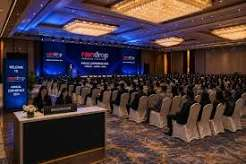
“Conference” sounds like one of the simpler corporate event formats on paper — people sit, someone presents, everyone goes home. In practice, the operational complexity scales up fast the moment you add multiple sessions, an actual delegate list instead of a guest list, and the expectation that the whole thing reflects well on the host company’s brand rather than just functioning logistically.
Scope varies more than the single word “conference” suggests. A smaller internal seminar for fifty employees has very different requirements from an industry conference drawing two hundred external delegates, which is different again from an international conference bringing in attendees from outside India entirely. Each step up in scale changes what actually needs planning — a seminar mostly needs a good room and a clear agenda; an international conference needs travel coordination, possibly visa-related guidance, multilingual materials in some cases, and a level of contingency planning that a single-day internal event simply doesn’t require.
Venue selection for a conference carries its own specific checklist that’s easy to underweight if you’re used to booking venues for other event types. Breakout room availability matters the moment an agenda includes parallel sessions rather than one continuous track. AV capability needs to handle presentations, panel discussions, and increasingly a hybrid or live-streamed component for delegates who can’t attend in person. Accessibility for delegates travelling from outside the city — proximity to airports or major transit, nearby accommodation options — affects attendance in a way that’s invisible until it shows up as a lower turnout than expected.
Stage and AV setup deserves its own line of focus separate from general event production, because a conference stage is being used continuously for hours rather than for a single key moment. This is where dedicated conference planning services in Delhi NCR earn their keep — handling stage configuration for multiple speakers and panel formats, reliable microphone and presentation systems that don’t fail mid-session, and increasingly the technical setup needed to stream sessions to a remote audience without it feeling like an afterthought bolted onto the in-person event.
Delegate management is the layer that, done well, is invisible, and done poorly, is the thing everyone remembers about the event. Registration needs to be smooth on arrival, not a bottleneck at the door. Badges, name tags, and access control for different ticket tiers or session types need to actually match what was promised during registration. For events drawing delegates from outside the city, coordinating travel and accommodation logistics — even just providing clear guidance rather than managing it directly — measurably affects how smoothly the event experience feels from a delegate’s first contact with the event.
Branding integration is worth treating as a planning requirement, not a decorative afterthought added once the logistics are locked. A conference is one of the more visible, sustained representations of a company’s brand that an external audience will experience directly — stage backdrops, signage, presentation templates, even the registration desk should reflect the same identity consistently, rather than feeling like a generic venue with a company logo pasted onto it.
Budget for a conference breaks down into a few major categories worth tracking separately rather than as one lump figure: venue and room rental, AV and technical production, branding and signage, catering, and delegate-facing materials like badges and kits. Catering in particular tends to be underestimated for multi-day conferences with networking meals built in, since per-delegate food and beverage costs across two or three days add up faster than a single-event budget might suggest.
What happens after the conference ends is worth planning for as deliberately as the event itself. Recording keynote sessions and panel discussions turns a single-day event into content that can be repurposed for months afterward — clips, quotes, and highlight reels extend the value of the conference well past the day it actually happened. A short delegate feedback survey, sent while the event is still fresh, also gives genuinely useful data for improving the next one, which a verbal debrief alone rarely captures with the same accuracy.
Date selection deserves more thought than it usually gets. Major Indian festivals, school holiday periods, and competing industry events in the same sector can all quietly depress attendance if a conference date lands on top of them without anyone checking the calendar first. A quick cross-check against the festival calendar and known competitor or industry events in the same space is a five-minute task that avoids a genuinely costly scheduling mistake.
It’s also worth planning a conference with an eye on the rest of the marketing calendar rather than treating it as a standalone event. A company already working with a corporate event management company for other initiatives gets more consistency — in branding, in vendor relationships, in institutional knowledge about what worked last time — by keeping the conference within that same relationship rather than sourcing a separate specialist purely for this one event.
Some conferences also benefit from extending their reach beyond the delegate list itself. A B2B or industry conference reaches a relatively narrow, invited audience by design; a parallel or follow-up mall activations campaign can put a simplified version of the same message in front of a much broader consumer audience, particularly useful when the conference’s underlying theme — a new product line, an industry position, a brand relaunch — has relevance beyond the room it was originally presented in.
None of this turns conference planning into something mysterious. It’s a checklist with more steps than most other corporate event formats, and a higher cost of getting any one step wrong, simply because delegates notice friction more readily than party guests do. Getting the venue, AV, delegate logistics, and branding right — and planned as a coordinated whole rather than as separate boxes to tick — is most of what separates a conference people remember well from one they just attended.
